Restacking an Office

SUCCESSFULLY SOLVING
THE WORKPLACE
RUBIK'S CUBE

A restack looks simple on the surface, “just move a few teams around”, but in practice is anything but. Done well, a restack can unlock capacity, improve collaboration, reduce cost and set an organisation up for success. Done poorly, it can create disruption, resistance and a long tail of unintended consequences.
I often describe a restack as a Rubik’s cube. Every move affects several others, and the goal isn’t just to make one side look good, it’s to end up with the whole cube aligned. Each team move has a knock-on impact to the next team and therefore needs to be carefully thought through.
So what does a successful restack actually involve? And why is it worth investing the time to do it properly?
What is a Restack (and what it isn’t)
At its core, a restack is a strategic review of how teams are located within an existing workplace. It looks at:
Who sits where today
Who needs to sit near whom (and who doesn’t)
How many people are really using desks
How future changes in headcount, projects and ways of working will impact space
A restack is not just a series of ad-hoc moves reacting to immediate pressure. In fact, constant reactive moves are usually a sign that a restack is overdue.
A proper restack creates an agreed end state and a sequenced pathway to get there.
Why Organisations Restack
There are a few common triggers that tend to bring restacks onto the agenda:
Demand for desks exceeding supply
Growth in project teams, contractors or temporary staff
A shift to hybrid or flexible working that hasn’t been reflected in the layout
Compliance issues (e.g. too many desks for certified occupancy)
Upcoming lease events or the desire to exit or consolidate space
Leadership wanting better co-location of related functions
Often, several of these happen at once.

The hidden complexity
The challenge with restacks isn’t just physical space; it’s people, timing and trust.
Some of the complexities that need to be managed include:
Teams with “hard” location requirements
Confidential or sensitive functions
Technology constraints and lead times
Business as Usual (BAU) pressures that limit move windows
Change fatigue and resistance, especially if flexibility is increasing
Competing priorities across multiple business units
This is why successful restacks are planned, not improvised.
A Proven Approach to Restacking
In my experience, the most effective restacks follow a few consistent principles:
1. Freeze before you move
Introducing a temporary change freeze on ad-hoc moves creates breathing room to plan properly. It also signals that a coordinated solution is coming.
2. Design the end state first
Agree the optimal future stack before touching anything. This includes adjacency principles, flexi-desk targets, compliance requirements and growth assumptions.
3. Sequence intelligently
Moves rarely happen in a straight line. Sequencing needs to consider dependencies, swing space, physical works and business critical dates.
4. Combine change with benefit
Restacks are far more successful when moves coincide with tangible improvements such as better settings, upgraded spaces or clearer ways of working.
5. Engage early and often
People are far more accepting of change when they understand the “why” and have some influence over the “how”.
Restacks and flexible working
Many restacks today are closely tied to flexi-desking and hybrid working. This adds another layer of complexity, but also opportunity.
When desk sharing is introduced thoughtfully supported by data, storage solutions and clear protocols it can:
Reduce surplus desks
Improve utilisation
Enable consolidation or lease exits
Fund improvements to the quality of space
The key is that flexi-desking shouldn’t feel like something that is “done to” people. It should be part of a broader, well-communicated plan.

Tools matter (but don’t replace thinking)
A restack involves a huge amount of data: people, teams, desks, floors, constraints and sequencing. Trying to manage this manually quickly becomes challenging.
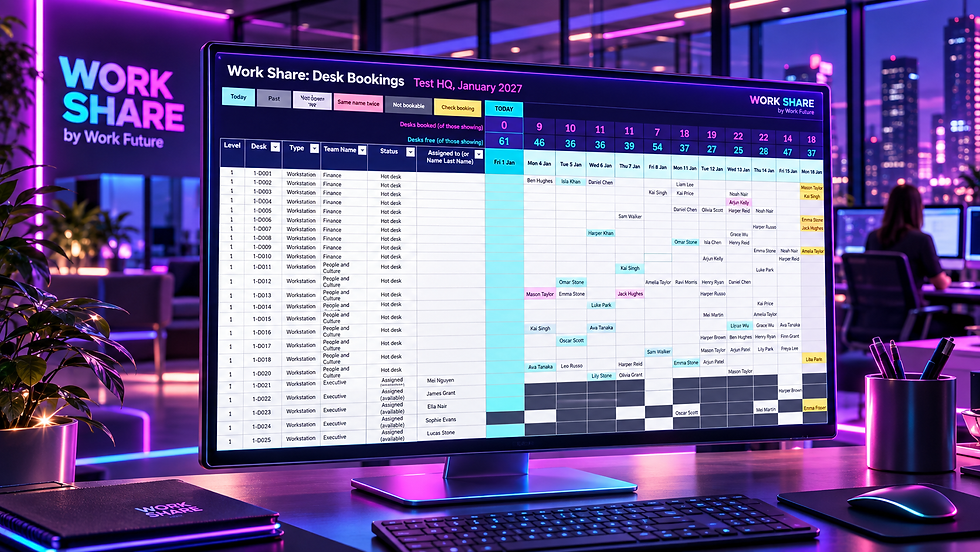
This is where purpose-built tools, such as Work Stack, can assist by first creating the current layout (a block & stack for the office as it is today), then enabling real time moves and changes to be made, which clearly show the impact of each move on desks, teams, floors and sequencing.
The whole process can therefore be streamlined for those planning the restack, by providing the required scenario modelling to support stakeholder engagement and ultimately reach agreements faster with the business.
In Summary
Restacks sit at the intersection of people, space and strategy and when approached thoughtfully, they can deliver benefits well beyond simply “fitting everyone in”.
The organisations that get the most value from restacks are the ones that treat them not as a logistical exercise, but as a strategic opportunity to reset how their workplace supports their business.
If you’ve been tasked with delivering an office restack, the challenge isn’t just moving teams around a floorplate. It’s making a series of interconnected decisions, explaining those decisions to others, and doing it in a way that holds up under scrutiny. Having the right structure, a clear view of impacts, and the ability to test scenarios before committing to moves can make the difference between a stressful reshuffle and a restack that genuinely sets the workplace up for success.